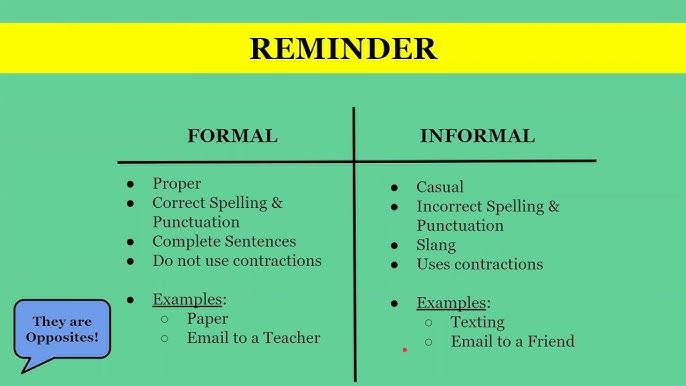
Writing can take many forms depending on your purpose and audience. The way you write an academic paper is not the same as the way you text a friend or write a social media post. Academic writing has a more serious, formal tone, while casual writing feels more relaxed and personal. Understanding the difference between these two styles is important for students because it helps you choose the right tone for every situation.
Academic writing is all about clarity, objectivity, and precision. You’re expected to sound professional and show that your ideas are based on evidence. It’s not about showing off vocabulary but about being clear and logical. In contrast, casual writing is informal, flexible, and often emotional. You can use slang, contractions, or humor. In academic writing, those would seem unprofessional.
One of the biggest differences is word choice. In academic writing, you use formal words and avoid slang or short forms. For example, in a research paper, you’d write “The results demonstrate a significant improvement” instead of “The results show a big improvement.” Casual writing, however, would use everyday words like “big,” “a lot,” or “good.” Academic tone values accuracy and neutrality, while casual tone values connection and expression.
Another difference is the use of personal pronouns. In casual writing, using “I,” “you,” and “we” is common and helps make the tone conversational. But in academic writing, especially in research papers, personal pronouns are used less often. Instead of saying, “I think this experiment worked,” you might write, “The experiment was successful based on the collected data.” The goal is to keep the focus on facts, not personal opinions.
Grammar and sentence structure also differ. Academic writing often uses complete, complex sentences with correct punctuation. Casual writing can be more flexible, with shorter sentences, fragments, and conversational pauses. In texts or blogs, people might write “So yeah, that’s what happened!” But in academic writing, you’d never use exclamation marks or phrases like “yeah.” You’d simply end your sentence formally.
Tone and attitude are also important differences. Academic writing must remain objective and polite, even when disagreeing with another scholar. You might write, “Previous studies present conflicting results” instead of “Some researchers got it wrong.” Casual writing, however, allows more emotion and directness — you can be playful or opinionated.
Another key feature of academic tone is evidence. You can’t make claims without support. If you say something, you need to back it up with data, research, or citations. Casual writing, on the other hand, can rely on personal experience or opinion. For example, a blog post might say, “In my experience, group projects are stressful.” But in an academic paper, you’d say, “Studies indicate that students often experience stress during collaborative assignments.”
Even formatting differs. Academic writing follows strict structures like introduction, body, and conclusion, often with citations and references. Casual writing can be more spontaneous. You can start with a story, use emojis, or end with a personal note. Academic tone is designed for analysis and education; casual tone is for conversation and storytelling.
Final Thought:
Both academic and casual writing have their place. Academic tone helps you sound credible and professional, while casual tone connects you with readers in a friendly way. Knowing when to use each shows maturity and skill as a writer. The real secret is balance — write with clarity, but always stay human.
How to Use AI Tools Ethically in Research Writing
AI tools have become part of everyday life in education. Students use them to brainstorm ideas, check grammar, summarize readings, and even generate outlines. But as useful as they are, AI tools must be used ethically. There’s a big difference between using AI for help and letting it do your work for you.
The first thing to understand is that AI should assist, not replace, your thinking. Tools like ChatGPT, Grammarly, or citation generators are helpful for improving clarity or finding references, but your original ideas should come from you. If you simply copy AI-generated text and submit it as your own, that’s academic dishonesty — just like plagiarism.
Ethical AI use starts with transparency. If your university allows AI assistance, mention it clearly in your methodology or acknowledgments. Say how you used it — for example, “AI software was used for grammar correction and citation formatting.” Being open shows integrity and builds trust with your readers and professors.
Another rule is to always fact-check AI outputs. Sometimes AI tools produce false or outdated information. Never assume everything is correct. Always verify facts from reliable academic sources. Remember, AI doesn’t think — it predicts text based on patterns. You’re responsible for ensuring your final work is accurate and credible.
AI tools can be great for generating ideas or finding research directions, but don’t let them shape your arguments completely. Use them as a starting point, not an endpoint. The thinking, analysis, and interpretation must still be your own.
Be cautious when using AI for paraphrasing or summarizing. Over-reliance on these tools can lead to unintentional plagiarism. Read the material yourself, take notes, and then write your own version. AI should never replace understanding.
Data privacy is another ethical concern. Don’t upload confidential research data, personal interviews, or unpublished findings into AI systems. They might not guarantee data safety. Use AI on general, non-sensitive content instead.
Most universities are still developing their policies on AI use. Some encourage it, others forbid it, and many allow it only under certain conditions. Always check your institution’s rules before using AI in academic writing.
Final Thought:
AI is a powerful tool when used wisely. It can make your writing clearer and your research smoother — but it should never replace your mind. Ethical AI use means being honest, thoughtful, and responsible. Use technology to support your learning, not to skip it.
Leave a Reply